
Author: Caleb Walsh
Organization: MineSpec NSW
Expert in Mine Site Vehicle Compliance and Safety Standards
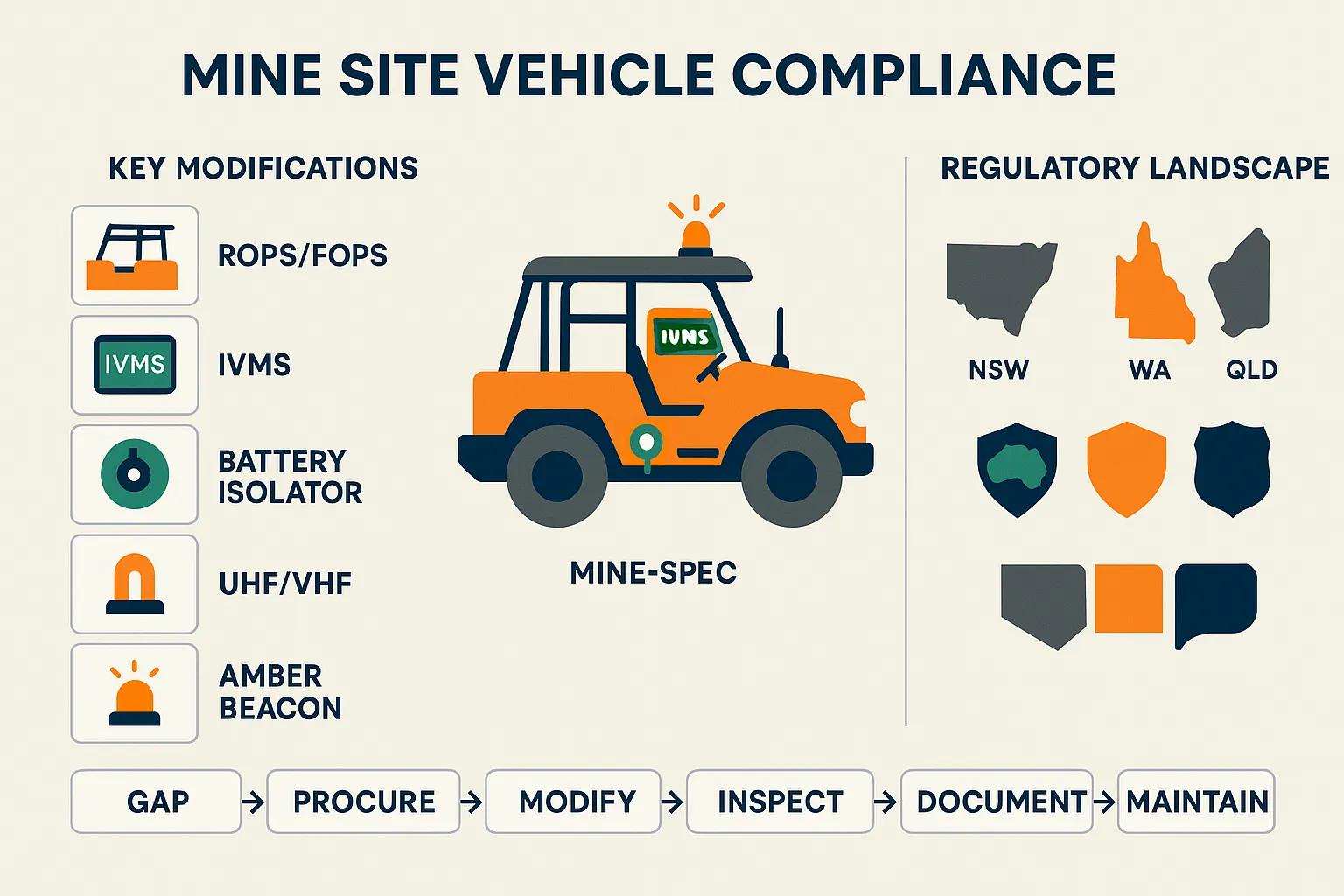
Mine spec vehicles are purpose-modified road vehicles adapted to meet mine site vehicle compliance and safety standards, enabling legal and operational access to active mining areas. This guide explains how to make a vehicle mine site compliant by mapping required modifications, certification steps, and ongoing practices that protect occupants and maintain fleet access. Many operators face denied entry, insurance exposure, or unsafe operating conditions because vehicles lack protection, communications, monitoring, or electrical safety features; this article provides practical solutions to close those gaps. You will learn what defines a mine spec vehicle, the essential safety modifications (ROPS/FOPS, IVMS, battery isolators, beacons, communications), how jurisdictional and major-miner rules affect requirements, and a step-by-step compliance workflow from assessment through audit-ready documentation. Each section contains actionable lists, EAV tables, and checklists designed for fleet managers, workshop technicians, and safety officers seeking clear, auditable pathways to mine site vehicle compliance.
A mine spec vehicle is a road or off-road vehicle modified and certified to meet the safety, communications, and monitoring expectations of a mining site; it reduces operational risk by protecting occupants and enabling site communications. Compliance works by adding engineered protection systems (for example, ROPS/FOPS), mandatory communications (UHF/VHF radios, beacons), electrical safeguards (battery isolators, wiring protection), and monitoring (IVMS) so vehicles meet both regulatory and contractual obligations. The immediate benefit is safer crews, fewer incidents, and lawful access to sites where non-compliant vehicles can be refused entry. Understanding these categories — protection, visibility, communications, electrical safety, and monitoring — makes it easier to plan modifications and certification pathways that align with site rules and state regulations.
A mine spec vehicle typically includes the following key features: our services
Each feature has a clear function: ROPS/FOPS protect occupants from rollovers and falling objects; beacons and flags enhance visibility in high-traffic areas; radios ensure coordinated movement and emergency contact; isolators prevent electrical fires and enable safe isolation during maintenance; IVMS provides location, speed and event logging for audits. These components form a systems-level approach where Protection → Enables → Safer Operations and Visibility → Enables → Incident Prevention, creating a coherent safety architecture for mine environments.
Vehicle compliance reduces the probability and severity of incidents by ensuring vehicles are physically prepared for the hazards present on mining sites, and by creating auditable records that satisfy regulators and operators. Non-compliant vehicles can cause operational delays, be denied access at the gate, and increase insurance and regulatory scrutiny; conversely, compliant vehicles support uninterrupted operations and lower reputational and financial risk. Compliance also supports a proactive safety culture: certified modifications and IVMS data provide objective evidence for continuous improvement. Recognizing these operational and legal drivers helps fleets prioritize investments that deliver measurable safety and business continuity benefits.
Essential mining vehicle safety modifications fall into clear categories: structural protection, communication & visibility, electrical safety, monitoring systems, and emergency equipment. Each modification targets a specific hazard or audit requirement and collectively forms the “mine spec” baseline that many sites require for entry.
Different modifications map directly to safety requirements and operational benefits.
| Modification | Requirement / Typical Standard | Compliance Benefit |
|---|---|---|
| ROPS / FOPS | Certification to relevant engineering or manufacturer guidance | Protects occupants in rollovers and against falling objects |
| IVMS (In-Vehicle Monitoring) | Location, speed, idle, and event logging; auditable exports | Enables fleet monitoring, incident reconstruction, and site compliance records |
| Battery Isolator | Accessible isolation switch & secure wiring | Prevents electrical fire risk during maintenance and crash scenarios |
| UHF/VHF Radio & Antenna | Permitted frequency bands, durable mounting | Maintains site communications and emergency coordination |
| Amber Beacon & High-Vis Flags | Brightness/placement per site policies | Improves visibility and reduces collision risk |
This EAV table clarifies why each modification matters and what it achieves for safety and compliance. Practical procurement routes include specialist vehicle modification services, certified installers for structural work, IVMS providers for monitoring platforms, and suppliers of engineered ROPS/FOPS systems. Engaging credible suppliers early helps secure auditable certificates and installation records that support subsequent inspection and certification.
Roll-Over Protective Structures (ROPS) and Falling-Object Protective Structures (FOPS) are engineered frames or canopies that protect vehicle occupants by absorbing or redirecting impact energy during rollovers or when struck by falling debris. ROPS distributes forces to maintain a survivable space, while FOPS uses shielding materials to prevent penetration into the cab. Proper protection requires certified design, correct attachment points, and periodic inspections to detect corrosion or deformation. Retrofitting older vehicles demands a structural assessment and certified installation to ensure the modification integrates with vehicle chassis loads without introducing new failure modes.
ROPS Standards and Testing for Earthmoving Machinery Safety A ROPS (Roll over Protective Structure) structure is defined as a system that includes a mounting structure (or an integrated structure), which is mounted to the machine frame via a mounting system to provide crush protection for the operator. ISO 3471 is the most prevalent standard for most types of earthmoving machinery which specifies the structural performance requirements for a ROPS system. ISO 3471 requires a push test to certify a ROPS system. The requirements are force resistance in the lateral, vertical and longitudinal directions, and energy absorption in the lateral direction. There are limitations on deflections under the loading so Design Optimization of CAB Roof for Rops and Fops Failure, M Rudresh, 2014
Reliable communication and electrical safety accessories include robust UHF/VHF radios with durable mounts, high-visibility amber beacons, emergency stop/isolation switches (battery isolators), protected wiring looms, and secondary power cut-offs for crash scenarios. These devices are installed with secure routing, strain reliefs, and weatherproofing to maintain function in harsh mine environments. Integration with IVMS allows alarms and events captured by in-vehicle monitoring to be correlated with radio or beacon activity for faster incident response. Proper installation should be completed by trained technicians and verified through post-install testing to produce certificates for audit records.
State regulations and major mining company requirements jointly shape mine site vehicle compliance by setting baseline legal expectations and adding site-specific or company-level mandates that can be stricter than state minima. Jurisdictions such as New South Wales, Western Australia, and Queensland have regulatory frameworks that intersect with operator rules, while large miners commonly require additional systems like mandatory IVMS, specific alarm types, or extra visibility equipment. Reconciling state rules with company standards requires identifying both sources early and planning modifications that satisfy the stricter of the two where they overlap. Understanding this dual-layer governance helps fleets avoid rework and rejected certificates at site entry.

New South Wales, Western Australia, and Queensland each publish regulatory guidance and industry bulletins that inform vehicle expectations, including trends toward mandatory monitoring and standard accessory lists. Fleet managers should consult state regulatory bodies and use site inductions to confirm current expectations before scheduling modifications. Common mandates across these jurisdictions include requirements for structural protection, communications capability, and documented inspection records; recent trends emphasize IVMS adoption and digital reporting. To verify current rules, teams should check state regulator publications and request site-specific vehicle checklists during tender or induction processes.
| Entity | Jurisdiction / Company | Requirement Summary |
|---|---|---|
| New South Wales (NSW) | NSW regulators & industry guidance | Focus on WHS regulations, risk management, and specific equipment standards |
| Western Australia (WA) | WA regulators & industry guidance | Emphasis on structural protection, documented inspections, IVMS trends |
| Queensland (QLD) | QLD regulators & industry guidance | Similar baseline safety expectations; strong focus on auditable records |
| Major miners (examples) | BHP, Rio Tinto, FMG (company policies) | Often impose additional site-specific IVMS, alarms, and accessory specifications |
This comparison shows that while states set the legal baseline, major mining companies frequently add operational requirements that can increase the scope of necessary modifications. Practical navigation of these layers often involves using third-party compliance specialists who provide site-specific modification packages and documentation support to ensure vehicles meet both jurisdictional law and company rules.
Large mining companies typically publish detailed vehicle standards and acceptance criteria that are site-specific and may be stricter than state guidance; differences often appear in monitoring details (IVMS parameters), alarm thresholds, and accessory specifications like handbrake or reverse alarms. While specific company checklists are authoritative, operators should treat company requirements as categorical: many require IVMS with specific data exports, defined beacon placement, and documented certification from qualified installers. When preparing vehicles for multiple sites or clients, design to the most stringent typical requirement to reduce rework and maintain fleet flexibility.
A clear, auditable workflow reduces uncertainty: assess the vehicle against target site requirements, plan and procure required modifications, engage certified installers for physical work, schedule inspections and certification, and maintain consolidated documentation and IVMS records for audits. This sequence follows a logical audit trail: Assessment → Modification → Inspection → Certification → Documentation. The table below maps practical responsibilities and outputs so teams can adopt a repeatable compliance process.
| Step | Responsible Party | Documentation / Output |
|---|---|---|
| Gap Assessment | Fleet safety officer / auditor | Gap analysis report listing required mods |
| Procurement & Scheduling | Fleet manager / procurement | Purchase orders; modification plan |
| Modification & Installation | Certified installer / workshop | Installation certificates; test reports |
| Inspection & Certification | Independent inspector / certifier | Inspection report; compliance certificate |
| Record-Keeping & IVMS Setup | Fleet admin / IVMS provider | Audit-ready files; IVMS data exports |
This table clarifies who does what and which documents prove compliance; many workshops and service providers offer packaged offerings — pre-modification audits, certified installation, and inspection coordination — which help reduce administrative burden. Engaging installers and IVMS providers that issue auditable certificates simplifies the path from modification to site acceptance while maintaining traceable records for regulators and clients.
Begin by conducting a documented pre-modification audit to capture current deficiencies and to map modifications to site requirements; this audit defines scope and supports procurement decisions. Choose installers who hold relevant engineering endorsements or who follow manufacturer guidelines for ROPS/FOPS fitment, and require post-installation testing with written certificates. After installation, schedule an independent inspection by a qualified certifier who will produce an inspection report and compliance certificate suitable for site submission. Maintaining clear handover documents and a single compliance folder per vehicle expedites gate checks and audits.
Essential documentation includes the initial gap assessment, purchase orders and modification plans, installation certificates from the fitter, independent inspection reports, and IVMS configuration/export files proving the device logs required data. Retain records in a centralized, audit-ready system with backups and access logs; recommended retention aligns with audit cycles and contractual obligations. For inspections, expect inspectors to verify structural attachments, electrical isolation installation, communications function, beacon placement, and IVMS reporting; compiling these proofs together reduces the risk of rejection at site entry.
Ongoing compliance is sustained through disciplined daily pre-start checks, scheduled maintenance and inspections, continuous driver training, and active IVMS monitoring with prompt corrective action. Daily checks detect new faults before a shift begins, while weekly and monthly maintenance ensures components like ROPS attachments, wiring harnesses, and communication equipment remain serviceable. IVMS data provides objective evidence that vehicles were operated within defined parameters and supports coaching when deviations occur. Together, these practices form a living compliance program that preserves safety performance and fleet access.
A concise daily pre-start checklist ensures vehicles enter operations in safe condition; key items include horn and radio test, beacon and lights check, battery isolator operation, seatbelt condition, and visible damage to ROPS/FOPS or mounts. Digital pre-start checklist systems capture timestamped records and photographic evidence, creating auditable trails and reducing paperwork. Escalation protocols should be clear: if safety-critical items fail, the vehicle is grounded and an incident report is generated before repairs. Weekly and monthly inspections cover wiring protection, mounting torque checks, and IVMS health checks to maintain certification integrity.
Daily pre-start checklist highlights:
Using a digital checklist improves traceability and allows trend analysis that feeds into scheduled maintenance planning, which in turn supports long-term compliance and risk reduction.
Driver training focuses on competency areas such as communications protocol, correct use of isolation switches, pre-start procedures, and understanding IVMS alerts; regular refresher training prevents skill decay and aligns behaviour with site expectations. IVMS supports coaching by providing objective metrics — speed, harsh braking, idle time, and geofencing events — which trainers can use to apply targeted interventions. Establishing metric thresholds and escalation pathways (warnings, retraining, or disciplinary action) reinforces compliance and reduces repeat non-compliance. Data-driven coaching closes the loop from monitoring to behavioural improvement and sustained compliance.
This FAQ section answers concise, high-impact questions that commonly guide field decisions and procurement choices for mine spec vehicle requirements. Short answers focus on essential accessories, variability across sites, and how to confirm requirements before scheduling modifications. Each item links back to the detailed sections above for teams that require deeper guidance and templates.
High-impact accessories typically required across many sites include ROPS/FOPS, IVMS units, battery isolators, UHF/VHF radios, amber beacons, fire extinguishers, first aid kits, and high-visibility flags. Each accessory serves a specific safety or compliance function: ROPS/FOPS for structural protection, IVMS for monitoring and auditable records, isolators for electrical safety, radios for communications, and beacons/flags for visibility. While some accessories are commonly mandatory, sites may vary in specification, so plan to check requirements ahead of delivery. Procuring accessories through certified suppliers and ensuring installers provide written installation certificates simplifies acceptance at site gates.
Top accessories and one-line purposes:
These core items form the baseline of a mine spec vehicle; additional accessories are selected based on site or company-specific standards.
Regulations vary because sites assess local hazards, operational layouts, and company-level risk tolerances differently; this leads to differences in IVMS data requirements, accessory specifications, and inspection frequencies. Primary verification sources include state regulators, company vehicle standards and inductions, and site-specific vehicle checklists provided during tendering or contractor onboarding. When requirements differ between jurisdictions or clients, adopt the stricter applicable standard or maintain modular configurations that can be adjusted per site to avoid repeated refits. A verification checklist prior to modification scheduling prevents costly rework and supports timely site access.
Verification checklist when preparing a vehicle:
Following these steps reduces the risk that a vehicle will be rejected at the gate and ensures investments in modifications deliver long-term operational value.
Using non-compliant vehicles on mine sites can lead to serious consequences, including denied access to the site, increased insurance premiums, and potential legal liabilities. Non-compliance may also result in operational delays, as vehicles may be required to undergo modifications or inspections before being allowed entry. Additionally, the safety of the crew is compromised, increasing the risk of accidents and injuries. Therefore, ensuring compliance is not only a legal obligation but also a critical aspect of maintaining a safe working environment.
Mine site vehicles should undergo inspections regularly, typically at least once a year, or as specified by local regulations and company policies. Additionally, routine checks should be conducted daily before operations to ensure that all safety features are functioning correctly. Scheduled maintenance and inspections should also be aligned with the vehicle’s operational hours and any specific site requirements. Keeping a detailed log of inspections and maintenance activities is essential for compliance and to ensure the safety of all personnel on site.
Operators of mine spec vehicles are required to undergo specific training that covers safe operation practices, emergency procedures, and the proper use of safety equipment. Training should include familiarization with the vehicle’s features, such as ROPS/FOPS, IVMS, and communication systems. Regular refresher courses are also recommended to ensure that operators remain updated on safety protocols and compliance requirements. Additionally, training should address the importance of conducting daily pre-start checks and responding to IVMS alerts to maintain safety standards on site.
For vehicle compliance audits, essential documentation includes the initial gap assessment report, modification plans, installation certificates from certified fitters, independent inspection reports, and IVMS configuration files. It is crucial to maintain a centralized, audit-ready system that includes all records related to modifications and inspections. This documentation not only supports compliance but also provides evidence of adherence to safety standards during audits. Regularly updating and reviewing these documents ensures that they remain current and accessible for inspection purposes.
Technology plays a significant role in maintaining vehicle compliance through the use of In-Vehicle Monitoring Systems (IVMS) and digital checklists. IVMS provides real-time data on vehicle performance, location, and operational metrics, which can be used for audits and incident analysis. Digital pre-start checklists streamline the inspection process, allowing for timestamped records and photographic evidence of vehicle conditions. Additionally, software solutions can help manage documentation, schedule maintenance, and track compliance status, making it easier for fleet managers to ensure ongoing adherence to safety standards.
A comprehensive pre-start checklist for mine spec vehicles should include checks for the functionality of communication systems (UHF/VHF radios), visibility equipment (amber beacons and lights), and electrical safety features (battery isolators). Operators should also inspect ROPS/FOPS for visible damage, ensure that emergency equipment like fire extinguishers and first aid kits are present and in date, and verify that seatbelts are operational. Documenting these checks helps create an auditable trail and ensures that vehicles are safe for operation before entering the mine site.

Commercial vehicle servicing in Hunter Valley keeps mining, civil construction,
Fleet managers across the Hunter Valley — including Rutherford and
The approved extension gives contractors and fleet operators greater certainty
mine site, first aid kit, mining, mine spec vehicle, western australia, queensland, contractors, msha, wheel chocks, safety standards, operator, ivms, guide, equipment, mine spec, battery isolator, fuel level, headlights, vehicle, maintenance, compliance, safety equipment, community, safety requirements, wipers and washers, transmission fluid level, frequently asked questions, mining industry, heavy equipment inspection checklist, emergency stop buttons, inspection checklist, heavy equipment, mining sites, inspection, safety features, vehicle inspection report, requirements, vehicles, safety, heavy equipment inspection, inspection report, mine safety, skip to content, backup alarm, work order, australia, fire extinguisher, mining company, rops, mine sites, operators, contact us, cost savings, fleet upgrade, performance, reliable, worker safety, operations, excavators, retrofit, mining operation, fleet, modification, emission standards, engineered, diesel engines, mining trucks, fires, technical, service, solutions, infrastructure, flexible, mining equipment, systems, fire, upgrades, mining operations, transporting, operational needs
mining site vehicle checklist, mining company vehicle policy, australian mine spec vehicle rules, vehicle compliance checklist for mining, off road vehicle requirements for mining, mining fleet compliance, fleet mine compliance upgrades